home contact us links trade show

Portable Hardness Tester

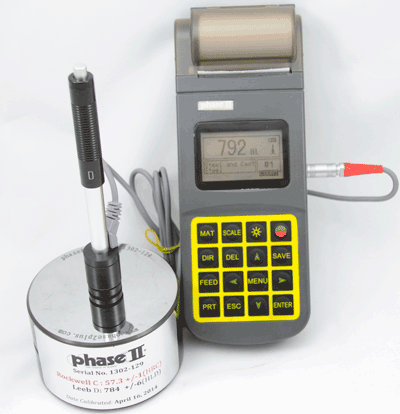
Model No. PHT-3500

State of the art, digital tester is designed to test the hardness of large hard metal parts. Loaded with useful functions and a built in mini-printer the PHT-3500 is clearly the industry leader for fast accurate hardness testing with advanced USB output and thermal printing capabilities.

The PHT-3500 can perform tests that easily convert to the most popular hardness scales, including Rockwell, Brinell, Vickers, Shore, etc.

Designed to test large hard parts:
Example: Tool steel should be close to 1” thick of solid material

 
Ultrasonic Portable Hardness Tester

Operation:
• Load the impact body
• Place the impact body on your test piece
• Push the button to begin testing and obtain reading

Standard Accessories:
• Base instrument
• Impact device D
• Calibrated test block
• Custom carry case
• Cleaning brush
• Operation manual

Optional accessories:
• Impact devices; DC, D+15, DL, G, C
• Special support rings
• Mini Printer

Functions:
• Easy to use keypad operation
• Auto identification of Impact Device
• Large LCD display with back light
• USB Ouput
• Automatic conversions to: Brinell, Rockwell B & C, Vicker and Shore
• Automatic mean value as well as Min & Max values
• Battery Indicator
• Memory capacity (100 groups)

Specifications:
• Accuracy: +/- 0.5% (referred to L=800, 
• Repeatability accuracy: +/- 4L units) L=Leeb
• Measuring range: 200-960 HL
• Materials: steel & cast steel, alloy tool steel, stainless steel, grey cast iron,
• spheroidal iron, cast aluminum, brass, bronze, wrought copper alloy.
• Battery type: AA alkaline (4)
• Operating temperature: 5-104 degrees F
• Dimensions: 150 x 74 x 32mm
• Weight: 245 grams 


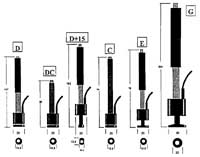
Special Application Impact Devices 

Impact Device D
Universal standard device: 
Use for the majority of hardness testing assignments
Impact Device DL (not shown)
Needle front section .109” diameter x 1.96” length
Measurements in extremely confined spaces
Impact Device G
Enlarged test tip: For use on solid heavy components such as; rough castings and forgings. Brinell only.
Impact Device DC
Extremely short impact device
Used for very confined spaces such as holes, cylinders, internal measurements
Impact Device D+15
Slim front section with coil set back.
Hardness measurements in grooves, recessed surface.
Impact Device C
Reduced impact energy
For testing case hardened or thin walled components


PORTABLE HARDNESS TESTING

Why portable hardness testing? Portable hardness testers have come of age since the late 90’s, with a vast offering of high tech, digital instrumentation. Small, compact and menu driven, these instruments have never been easier to use for unlimited types of applications.

There are two basic methods of portable hardness testing that is accepted in the field today.
“Dynamic Impact” is based on the Leeb principle of hardness,developed by Dietmar Leeb in the 1970’s. A spring loaded impact body is thrust to the test surface, effecting rebound. The speed of both the initial thrust and the rebound is measured in a non-contact mode. This is calculated as a Leeb hardness value and then automatically converted to Rockwell C, B, Brinell, Vickers and Shore Values. It has effectually brought easy, fast and accurate results to portable hardness testing.

Voltage characteristic of output signal

“Ultrasonic Contact Impedance” is based on a 136 degree diamond at the end of a vibrating rod being depressed into the test surface at a fixed load. The difference in Ultrasonic vibration frequency is then calculated into a hardness value. The UCI test procedure is slower than the Dynamic Impact style, however the “UCI” method of hardness testing is portable, easy and accurate. It also has its own advantages when utilized for certain testing applications. UCI testers are not restricted to large mass items like dynamic type testers. These units can test metals as thin as 1mm and at a hardness value as low as 20HRC (75HB). They also excel at performing hardness tests on larger, harder metals as well. Another reason for the rise in popularity is due to the fact that the UCI method is categorized as  “Non-Destructive”. That translates into less scrap parts/ lower mfg costs due to necessary inspections.

Technical Data for Dynamic Impact Devices


Impact Devices
D/DC/DL D+15 C G
Impact energy 11Nmm 11Nmm 3Nmm 90Nmm
Mass of the impact body 5.   5g 7.  8g 3.  0g 20g
  DL: 7.3g      
Test tip        
* Hardness 1600HV 1600HV 1600HV 1600HV
* Diameter 3mm 3mm 3mm 5mm
* Material   Tungsten Tungsten  
*   carbide carbide  
Impact device        
* Diameter 20mm 20mm 20mm 30mm
* Length 147/86mm 162mm 141mm 254mm
* Weight 75/50g 80g 75g 250g
Max. hardness of sample 940HV 940HV 1000HV 650HB
Preparation of surface        
* Roughness class ISO N7 N7 N5 N9
* Max. roughness depth Rt 10 µ m 10 µ m 2.5 µ m 30 µ m
* Average roughness Ra 2 µ m 2 µ m 0.  4 µ m 7 µ m
Min. weight of sample        
* Of compact shape 5kg 5kg 1.5kg 15kg
* On solid support 2kg 2kg 0.5kg 5kg
* Coupled on plate 0.  1kg 0.  1kg 0.  02kg 0.  5kg
Min. thickness of sample        
* Coupled 3mm 3mm 1mm 10mm
* Min. thickness of layers 0.  8mm 0.  8mm 0.  2mm    -
Indentation of test tip        
With 300 HV        
* Diameter 0.  54mm 0.  54mm 0.  38mm 1.03mm
* Depth 24 µ m 24 µ m 12 µ m 53 µ m
with 600 HV        
* Diameter 0.  45mm 0.  45mm 0.  32mm 0.  90mm
* Depth 17 µ m 17 µ m 8 µ m 41 µ mC
with 800 HV        
* Diameter 0.  35mm 0.  35mm 0.  30mm    -
* Depth 10 µ m 10 µ m 7 µ m    -

Technical Data for UCI Hardness Tester


Test Device

U1
(UCI)

Length 160mm
Diameter 25mm
Indentation Depth 30µm
Pressure Force 14.7N
Transducer Test Life (approx) 200,000
Min. Thickness for test 1mm
Min. Radius for Test 5mm
Max Roughness of surface Ra 2.5µm
Max Archive 100 Tests
Time of Test 4 sec.

Comparison of Hardness Testing Methods-Phase II Models shown below

Data Dynamic Ultrasonic Rockwell
Requirements      
Surface Finish Smooth Smooth Smooth-Semi Rough
Rigid Support of Sample Yes Yes Yes
Test sample portability Not required Not required Required
Procedures      
Structural Steel Functional Functional Functional
Heat Treated Steel Functional Functional Functional (HRC)
Case Hardened Material Functional Functional Functional (HRC)
Non-Ferrous Metals Functional Functional Functional (HRB)
Large Samples Yes Yes Restricted
Small Samples Restricted Yes Yes (w/proper scales)
Thin Samples Restricted Yes Restricted
Curved/Round Surfaces Yes Yes Restricted
Special Features      
Automatic Test Procedure Yes Yes Yes
Direct Hardness Value Yes Yes Yes
Required Time for Avg/5 Tests Approx. 10 Sec. Approx. 20 Sec. Approx. 2 Minutes
Digital Display Yes Yes Some Models
Scale Conversions Yes Yes Some Models
Directional Testing Yes Yes No
Standardized by: ASTM ASTM NIST (HRC scale only)
Indentation Depth 20µm 30µm 160µm
Operator Requirements      
Skills Required Minimal Minimal Minimal
Possible Reading Error None None None
Instrument Features      
Portability Yes Yes No
Power Supply Battery Battery Manual/110v
Output to PC Yes Yes Some Models
Type Model Model
Dynamic Testers PHT-2000D PHT-2500D
Ultrasonic (UCI) MET-U1 MET-UD
Rockwell 900-331 & 900-340 900-360 & 900-370


HARDNESS TESTER RESOURCES
Hardness Tester Accessories Portable Hardness Testers
Hardness Tester Block Certification Minimum Thickness Chart for Rockwell Hardness Testing
Rebuilt Inventory with Full Warranty Rockwell Hardness Scale Indentor Load Chart
Hardness Tester Conversion Chart Hardness Setup:
  • 900-331
  • 900-340
  • 900-360
  • 900-370
  • Principle of Rockwell Hardness Testing NIST Links
    Roundness Correction Chart for Hardness Testing ASTM Links
    HARDNESS TESTER LINKS
    TRADE SHOWS
    • Visit our booth #6824 @ Quality Expo September 25-27, Rosemont, Illinois